LITERATURE tYPES

DEALER CATALOGUES
Frequently we are asked what the correct configurations are for installing a period correct radio into a vintage car. Original literature is extremely difficult to find, yet over the years we have collected a variety of Blaupunkt literature that shows an abundance of information for most vehicle models of that era and earlier. We collect early repair manuals, installation diagrams and dealership correspondences as well. These items go into our collection and are not made available for sale. We will be adding similar information for Becker in the near future.
Our aim is to share this information by making it available to the public. The images below show the various radios Blaupunkt made available for individual vehicle models. Interesting are the images of the radios installed in the dash of various classic cars. Interesting as well are the prices shown. These were not inexpensive accessories!

Customer Brochures
The radios shown below are not all of the radios Blaupunkt offered. A number of other radio variants were available depending on the bands offered within a given area. One example is the longwave band. While some areas on some continents offered longwave bands such as Europe, longwave was never made available in the US. Other continents such as Africa had Blaupunkt radios that focused on shortwave, making the button layout lock in to various shortwave frequencies. While some radios were factory installed, many were installed at the dealership, allowing customers to choose the model they preferred.
Radio Models
Unlike today, purchasing a radio in the 1950's and 1960's was an investment. Of particular interest below are the prices in Deutschmarks that show how expensive these radios actually were. At a time when a new standard 1966 Volkswagen Beetle cost DM 4635.- the Koln radio cost DM 595. In other words, the price for 7.8 Koln radios was the same as a new car. Hard to imaging in todays world of throw-away consumer products.

Blaupunkt Köln
DM 595.-
This mid-1966 Blaupunkt Köln is the top-of-the-line model built by Blaupunkt and offered auto-seek. The price was a 1/8th the cost of a new Volkswagen Beetle.
Blaupunkt New Yorker
DM 545.-
FM,AM, Marine-band. On/Off and tone operated by left shaft. Five preset buttons. Auto-seek by pressing right shaft. Listed as an "ExportSuper" this model was later renamed "New Yorker",
Blaupunkt Frankfurt
DM 389.-
This mid-1966 Blaupunkt Frankfurt model is for the European market and offered Longwave, which the US model didn't, although the FM only went up to 104.
Frankfurt US Model
DM 389.-
This early-1966 Blaupunkt Frankfurt was intended for the US market and offered FM up to 108. This image mistakenly shows white US market pushbuttons, which never existed for this year and model for the US market.
Blaupunkt Essen
DM 298.-
The early 1966 Essen was the least expensive FM radio that Blaupunkt offered at the time. It had FM, AM and Longwave. On/Off operated by left shaft. Tone adjusted by buttons. No presets.
Blaupunkt Stuttgart
DM 268.-
This early 1966 Blaupunkt Stuttgart was the most expensive non-FM radio available and offered AM, longwave and shortwave. It had five preset buttons and identical internals as the Frankfurt only lacking the FM band.
Blaupunkt Hamburg
DM 249.-
Blaupunkt Hamburg: AM and longwave only. On/Off and tone operated by left shaft. Least expensive radio with presets.
Blaupunkt Bremen
DM 199.-
Blaupunkt Bremen: The least expensive radio Blaupunkt offered. AM and longwave only. On/Off and tone operated by button, not the left shaft. No presets.
Blaupunkt KV 900
DM 130.-
KV 900: Shortwave accessory unit. Under dash mounted shortwave receiver that plugs into DIN port in back of some radio models.
Unusual Radio Models
Some areas of the world commonly used and prioritized different bands. This is a page from a Blaupunkt catalogue for the South American market. Even more varieties of non-European or US market Blaupunkt radios were offered in Africa and Asia. While the Export-Super can be found in the US at times, the Hannover is a true oddball.

Blaupunkt Date Codes
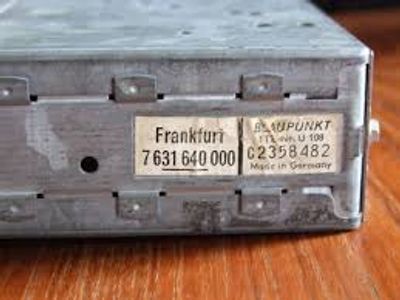
Most Blaupunkt radios have a paper tag on the right side of the radio body that shows a letter code indicating its “series”. This letter code always refers to a two-year span in which a specific series was produced (for example: A-series = 1969-1970), since new models were mid-year introductions.
Although this paper tag is almost always on the right side (passenger side of the car when mounted) of the radio, on early tube radio (circa 1955-58) the paper tag is on the left side. During the transition period in which tags moved from the left to the right, there are even radios that have two paper tags, with one on each side.
Depending on heat and humidity, these paper tags have often fallen off, since they were held in place with a dab of glue. The 1950’s and 1960’s radios have a higher chance of the paper tag still being present (more or stronger glue?), while the 1970’s radios have a smaller chance of the paper tags being in place.
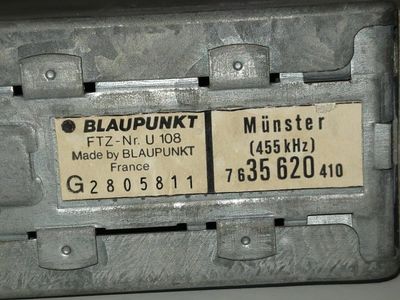
The paper tags with the letter code also have a serial number. It is my understanding that the serial number on 1950’s and 1960’s radios are just the numeric order in which a certain radio was produced in that series. And until the Z-series 1968-1969 model, an old series was immediately discontinued once the new model year series was introduced. For example, a W-series will always be from 1965 and 1966 and will not have been produced any later than that.
This changed starting with the A-series 1969-1970 models. Some series continued being built for a few additional years, meaning that an old series was not immediately discontinued once the new model year began. It is the model code (not the serial number, which is usually located next to it) that gives us more information with the fourth digit indicating the year that radio design was originally introduced. This information works hand-in-hand with the letter code, which tells us the actual year the radio was built.
Examples:
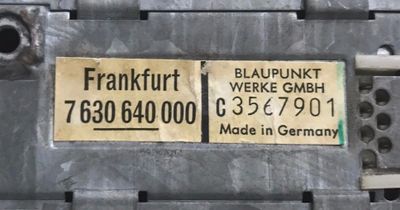
Model Code: 7630 640 000 with C-series is a 1970 design built 1971/1972
Model Code: 7632 641 200 with F-series is a 1972 design built 1974/1975
Model Code: 7631 640 000 with D-series is a 1971 design built 1972/1973
Letter Series Date Codes
Letter Series Codes:
1955-1956- R 1956-1957- K 1957-1958- S 1958-1959- G
1959-1960- Q 1960-1961- D 1961-1962- E 1962-1963- T
1963-1964- U 1964-1965- V 1965-1966- W 1966-1967- X
1967-1968- Y 1968-1969- Z 1969-1970- A 1970-1971- B
1971-1972- C 1972-1973- D 1973-1974- E 1974- 1975- F
1975-1976- G 1976-1977- H 1977-1978- G 1978-1979- G
Important Blaupunkt Radio Facts
Green versus white dial face?
All T-series (1962/1963) and earlier Blaupunkt radios had a green dial no matter what model radio or which vehicle a radio was intended for. The green dial was not specific to any one vehicle as some people believe. This holds true for both European market radios as well as US market radios. During the following model year, the U-series (1963-1964) had the dial color changed to white, no matter what model radio. Note: Some 1970's European model Blaupunkt radios changed back from white to green dial faces.
When was shortwave added?
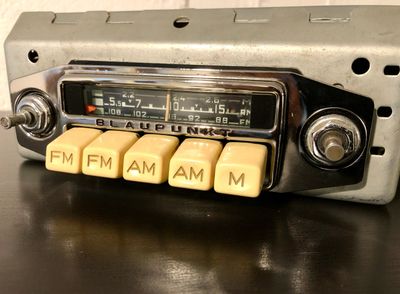
The Marine band feature on US market radios was dropped and shortwave added with the introduction of the W-series (1965-1966). Previously the buttons were labeled M,AM,AM,FM,FM. They were changed to AM,AM,SW,FM,FM. Shortwave was available before 1965 though using a seperate undermount shortwave adapter such as the earlier "big button" KV 810 or later "small button" KV 900. Shortwave was added to the European market radios as well beginning with the W-series (1965-1966). Previously the buttons were labeled L,M,M,U,U. They were changed to L,M,K,U,U.
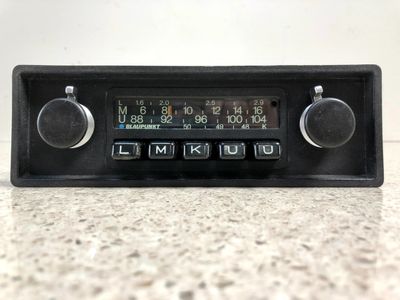
What are "M", "L" "K" or "U" buttons?
The “M” button on a US market radio is the marine band, while the “M” button on a European market radio is the AM band. "L" stands for longwave (not applicable in the US, although it can at times pick up international stations at higher altitude on a clear night), "K" stands for shortwave and "U" stands for FM on European models.
The FM range, US market verses European market radios:
The FM range on US market radios always goes up to 108. The FM range on European market radios only goes up to 104 and even only up to 100 on earlier European market tube radios from the 1950's. The only European model Blaupunkt to break this rule are some Dortmund deluxe models from the early 1970’s and the export version of some Volkswagen specific Emden models. These were offered with a 108 FM range
Knobs, Speakers and Antennas
Unlike today, purchasing a radio in the 1950's and 1960's was an investment. Of particular interest below are the prices in Deutschmarks that show how expensive these radios actually were. At a time when a new standard 1966 Volkswagen Beetle cost DM 4635.- the Koln radio cost DM 595. In other words, the price for 7.8 Koln radios was the same as a new car. Hard to imaging in todays world of throw-away consumer products.
Blaupunkt Knobs
All knobs before the 1967/1968 Y-series had knobs with set screws (usually two). The set screws are slotted, sometimes seize and crack when removed.
Knobs And Levers
The Y-series itself had a partial "D-shaft" for knobs with either set screws or push on knobs. Starting with the 1968-1969 Z-series, all knobs were push on.
Blaupunkt Speakers
Flush mount speakers were very specific in shape and size. The oval 911/912 speakers wasn't used on any other vehicle model. The some goes for the long narrow Mercedes speaker.
Frankfurt Speakers
Top mount speakers changed over time in style and shape. Earlier examples were decorative, colorful and chrome. Later examples have a muted plastic look.
Blaupunkt Speakers
-
"Through-mount" speakers with grills. These were often used as an accessory speaker on the parcel tray in the 1950's and early 1960's.
Blaupunkt Speakers
Its surprising how well these old speakers generally work. Being hard sprung without foam edges, they often withstand the test of time.

Blaupunkt Antennas
Blaupunkt Antennas
Blaupunkt Antennas
Radio Packaging
Most packaging is usually thrown away. If kept, it is often damaged by moisture or faded by the sun. Unlike the radios themselves, original packaging is extremely difficult to find in good condition. Especially interesting is how the packing design changed to reflect people's taste.
Mid 1960's Packaging
The highly decorative packaging of the mid-1960's looks colorful and fun. This packaging is very "Blaupunkt-blue".
Late 1960's Packaging
In contrast, the late 1960's packaging is minimalistic and somewhat bare, although it does retain some of the "Blaupunkt-blue".
Early 1970's Packaging
This 1970-1971 B-Series packaging is unique because it allows the consumer to see the product through the plastic window. This packaging is now "Bosch-yellow".